
Quick Facts About MPGe
- MPGe, or miles per gallon equivalent, is the unit of measurement (33.7 kWh = a gallon of gas) for hybrids, PHEVs, EVs, and fuel-cell cars.
- The figure indicates how efficiently power is used and helps gauge energy cost.
- Higher MPGe figures mean more efficient energy use, not necessarily longer range.
If you’ve shopped for an electrified car, you likely encountered a term on the spec sheet or window sticker and wondered, “What is MPGe?”
Let’s dive deep into MPGe to explain what it is and how to use the number. These measurements will become much more prevalent as hybrids, plug-in hybrid electric vehicles (PHEVs), fully electric cars (EVs), and fuel-cell electric vehicles (FCEVs) become the new normal.
- What Does MPGe Mean?
- How Is MPGe Calculated?
- MPGe vs. MPG
- Electric Cars With the Best MPGe
- MPGe Misconceptions
What Does MPGe Mean?
MPGe stands for “miles per gallon of gasoline equivalent,” a measurement of fuel efficiency for hybrid and electric cars. Unlike a gas car’s mpg, which is calculated using a simple formula, such a figure is not obtainable when a battery from a hybrid, plug-in hybrid, or fully electric vehicle uses electricity as its fuel source.
That’s why the Environmental Protection Agency (EPA) introduced in 2010 the unit of measurement for the electric car’s energy consumption level to compare with gas-powered vehicles. MPGe helps consumers gauge the relative efficiency of EVs versus cars with combustion engines.
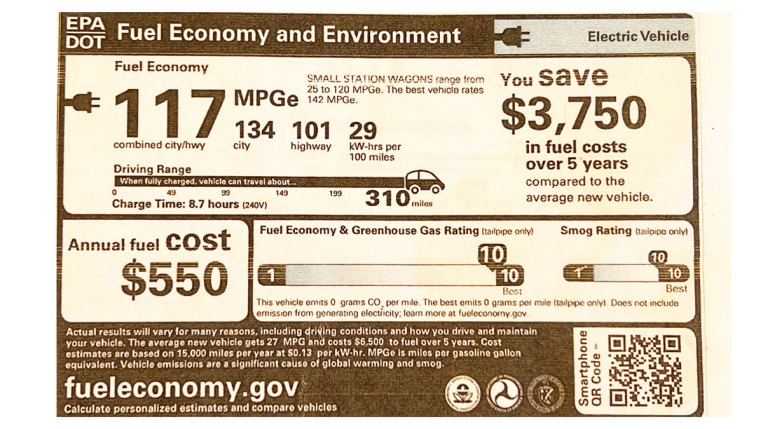
Every window sticker at the dealership (see the example above for the 2022 Kia EV6 GT Line) is federally mandated to show the MPGe when it’s an electrified car or the mpg when it’s a gas-fueled vehicle.
MORE: Electric Cars 101: What You Need to Know About EVs
How Is MPGe Calculated?
A car that uses 33.7 kilowatt-hours (kWh) of electricity to travel 100 miles rates 100 MPGe. When the EPA devised MPGe in the early 2000s, the government agency calculated that 33.7 kWh of electricity was comparable to a gallon of gasoline fuel in terms of energy content.
True, pulling 33.7 kWh of electricity from the grid in a place dependent on coal power is not quite the same as using wind power. However, such an average makes for a more reasonable comparison to drivers.
This equation is simple enough for fully electric cars that do not contain an internal combustion engine (ICE). The math gets trickier for a PHEV such as a Chrysler Pacifica Hybrid or a Toyota Prius Plug-in Hybrid. These vehicles use an MPGe rating when driven on electric power only, with conventional mpg ratings applying once their batteries deplete and their gas engines kick on.
MPGe is an important way to compare the efficiency of an electrified car because it is linked directly to the cost of charging the vehicle and the power the EV needs to draw from the grid to top off its battery.
MORE: 10 Best Electric Car Deals
MPGe vs. MPG
When it comes to MPGe for electric vehicles and mpg for gasoline-powered cars, they might seem very similar. But there’s a big difference between the two.
The formula for MPGe calculates as follows: 33.7 kilowatt-hours of electricity equals one gallon of gas. Some cars can get 100 MPGe. However, this can be misleading if you look at this number to see how much money you will spend on fill-ups. It would be more accurate to look at the car’s 5-Year Cost to Own and calculate how much your home electricity bill would be.
On the flip side, mpg is the gas equivalent to electric power. This number can be significantly lower than that of electrified cars. A car with 35 mpg is considered great, but EVs can easily get 100 MPGe.
The miles-per-gallon formula works like this: Miles driven divided by gallons used = mpg. This mpg formula is much easier to understand.
MORE: Safest Electric Cars of 2024
Battery-Powered Electric Cars With the Best MPGe
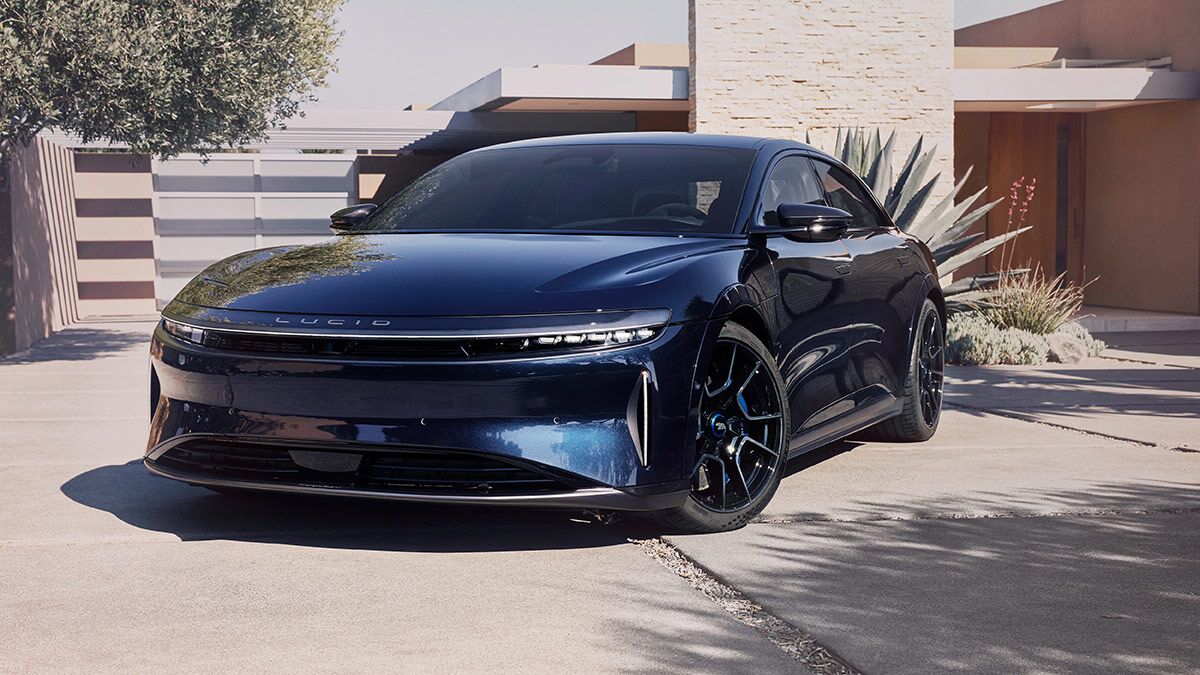
Expect this list to change rapidly over the next few years as fully electric vehicles become more common and advancements in battery technology make them more energy-efficient. You can find and compare cars on the Department of Energy’s fuel economy website.
Here is a chart listing EVs with the best MPGe ratings, their estimated annual fueling cost (using an electricity rate of 17 cents per kWh and a 15,000-mile annual estimate) rounded to the nearest $50, and their estimated electric range, according to EPA figures.
| 2025 Model | MPGe | Annual Fuel Cost | Range |
| Lucid Air Pure RWD (19-inch wheels) | 146 | $500 | 420 miles |
| Tesla Model 3 Long Range RWD | 137 | $550 | 363 miles |
| Hyundai Ioniq 6 Standard Range | 135 | $550 | 240 miles |
| Hyundai Ioniq 6 RWD | 132 | $600 | 342 miles |
| Lucid Air Touring AWD (19-inch wheels) | 132 | $600 | 406 miles |
| Lucid Air Pure RWD (20-inch wheels) | 129 | $600 | 372 miles |
| Tesla Model 3 Long Range AWD | 128 | $600 | 346 miles |
| Lucid Air G Touring XR AWD | 128 | $600 | 512 miles |
| Lexus RZ 300e (18-inch wheels) | 125 | $600 | 266 miles |
| Tesla Model Y Long Range RWD | 125 | $600 | 337 miles |
| Tesla Model S | 124 | $600 | 410 miles |
| Hyundai Ioniq 6 AWD (18-inch wheels) | 121 | $650 | 316 miles |
| Lucid Air Touring AWD (20-inch wheels) | 121 | $600 | 377 miles |
| Lucid Air G Touring XR (20-inch wheels) | 120 | $650 | 480 miles |
| Toyota bZ4X | 119 | $650 | 252 miles |
| Hyundai Kona Electric Standard Range | 118 | $650 | 200 miles |
| Telsa Model Y Long Range AWD | 117 | $650 | 311 miles |
| Hyundai Kona Electric (17-inch wheels) | 116 | $650 | 261 miles |
| Fiat 500e | 116 | $650 | 149 miles |
| Volvo EX30 Single Motor Extended Range | 116 | $650 | 261 miles |
| Lucid Ait Touring AWD (21-inch wheels) | 116 | $650 | 361 miles |
| BMW i4 eDrive35 Gran Coupe | 116 | $650 | 266 miles |
| Hyundai Ioniq 5 Standard Range | 115 | $650 | 245 miles |
| Kia EV6 Standard Range RWD | 115 | $650 | 237 miles |
| Audi Q4 45 e-tron | 115 | $650 | 288 miles |
MPGe Misconceptions
To be clear, good MPGe ratings don’t necessarily mean the best electric range. And MPGe is not tied directly to a vehicle’s speed or performance capability. Instead, a high MPGe rating shows that a car makes the best use of its electrical power.
MPGe does not offer a direct and accurate cost comparison because your mileage results will vary due to many factors, no matter which kind of fuel the vehicle uses.
For the 2026 model year, a new EV’s window sticker shows an estimated annual electric fuel cost based on 17 cents per kWh, close to the current national average residential rate. However, the cost of a kWh varies considerably by region and whether you charge the electric car at home or use a public charging station. The basic rule of thumb is this: Vehicles with a higher MPGe are more efficient than those with lower MPGe numbers.
Kelley Blue Book factors such information into its Total Cost of Ownership comparisons, which is helpful when evaluating how much a vehicle will cost an average driver over five years.
Editor’s Note: This article has been updated since its initial publication.